
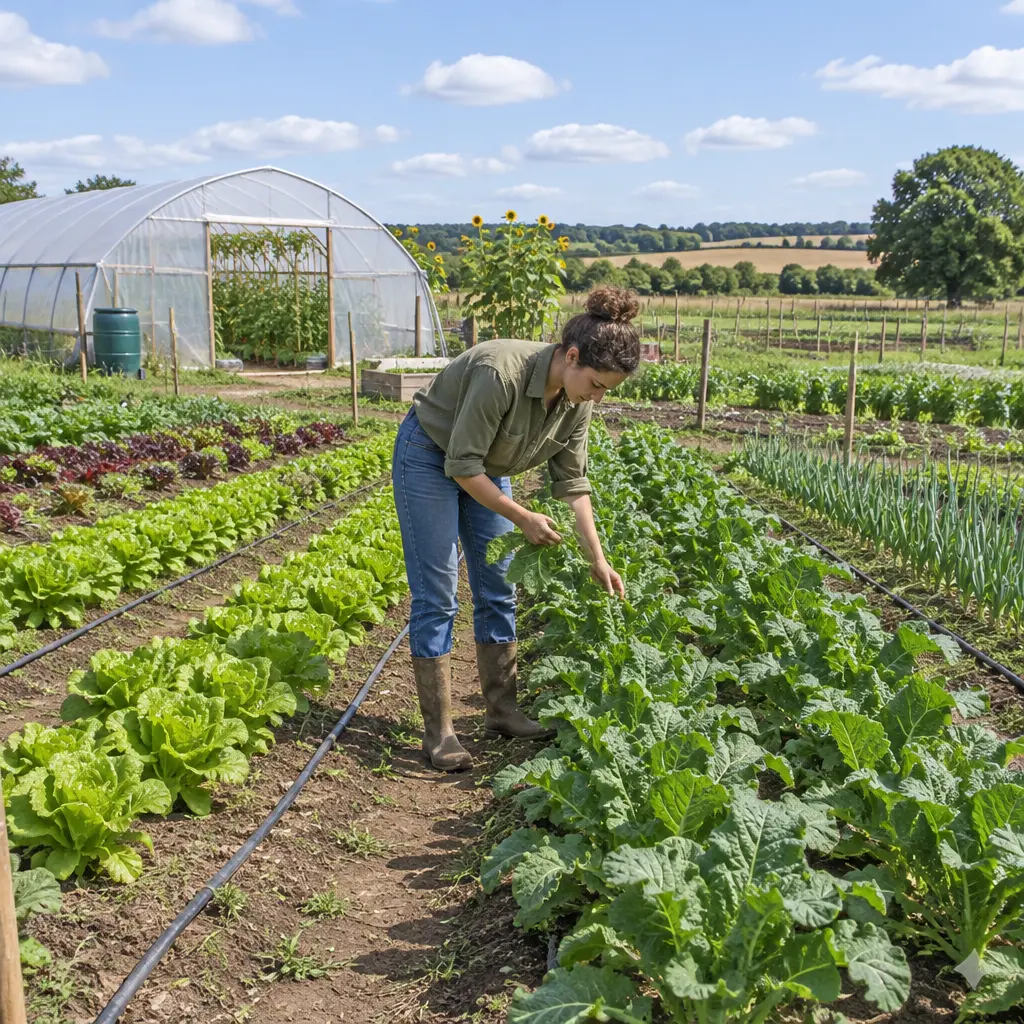
Agricultural income without land ownership is income earned by producing, managing, processing, or marketing farm goods while leasing, sharing, or accessing land through someone else. It can support a livelihood, but rarely through one universal formula: a workable plan combines secure access to land or facilities, a marketable product, realistic cost and labor estimates, and more than one revenue stream. USDA data show that U.S. farms are overwhelmingly family-operated, while land access and operating costs remain significant constraints; models such as leasing, custom services, contract production, and value-added sales offer alternatives to buying acreage, each with different risks and capital needs.
How agricultural income without land ownership works
Agricultural income without land ownership means earning from agricultural activity without holding the deed to the land used. The USDA Economic Research Service describes farm tenure through ownership, renting, and combinations of the two; for a non-owner, the crucial distinction is whether access is dependable enough to justify investment in crops, equipment, soil improvement, and customer relationships.
The main models include cash leasing, crop-share agreements, custom farm work, contract production, livestock or greenhouse operations on leased sites, and value-added or direct-market businesses that use land accessed through a partner. These approaches can reduce the large upfront cost of purchasing farmland, but they do not eliminate costs: rent, inputs, insurance, labor, transport, compliance, and marketing still determine whether the business makes money.
Land access is different from land ownership
Land access is a legal or practical right to use acreage, buildings, water, or other farm resources. It may come through a written lease, a crop-share arrangement, a cooperative, an incubator farm, or an agreement with an existing farm. The National Agricultural Statistics Service’s 2022 Census of Agriculture counted about 1.9 million U.S. farms and 880 million acres in farms, illustrating the scale of the sector—but acreage in farms is not necessarily available to new operators, and local land prices and rental rates vary widely.
For a tenant, the lease is a business asset. It should specify acreage, term, rent, permitted uses, water access, maintenance duties, improvements, renewal, and what happens to crops or infrastructure when the agreement ends. Short terms can make long-payback investments—such as irrigation, perennial plantings, or fencing—difficult to justify.
Income is not the same as profit
Farm revenue is the money received from products and services; profit is what remains after operating expenses, debt service, depreciation, taxes, and the value of the operator’s labor are accounted for. USDA’s 2022 Census reported that most U.S. farms had less than $50,000 in sales, a reminder that farm numbers alone do not indicate full-time livelihoods. A sound plan therefore estimates net income per enterprise and per hour, not just gross sales.
Leasing and shared-use arrangements create agricultural income
Leasing is a primary route into production without buying land. The USDA National Agricultural Statistics Service reported in its 2017 Tenure, Ownership, and Transition of Agricultural Land survey that roughly 39% of U.S. farmland was rented or leased, demonstrating that rented acreage is a substantial part of American agriculture. The percentage describes land tenure across the sector, not a guarantee that affordable land is available in every region.
Lease structures shift risk and reward in different ways. A cash rent lease provides predictable land cost but leaves the tenant exposed to yield and price swings. A crop-share lease divides production or revenue and can share risk, though it requires clear accounting and agreement on who pays for inputs. Shared-use farms and incubator programs may also provide tools, infrastructure, training, or marketing access in exchange for fees or participation requirements.
Cash-rent leases
A cash-rent lease is an agreement in which the operator pays a fixed amount to use land for a stated period. It suits producers who want operational control and can forecast whether sales will cover rent and other costs. The risk is that rent is owed even after drought, disease, or poor prices. Before signing, compare local rents with expected yields, check soil and water conditions, and model a bad-year scenario.
Crop-share and flexible leases
A crop-share lease compensates the landowner with an agreed portion of crop or revenue, sometimes alongside shared input expenses. A flexible cash lease adjusts payment according to prices, yields, or another agreed measure. These structures can align incentives and distribute risk more fairly than fixed rent, but the contract must define how production is measured, which costs are shared, and when payments are due. Local extension services and agricultural attorneys can help adapt standard lease templates to state law.
Incubator farms, cooperatives, and shared facilities
An incubator farm offers new growers temporary plots, shared equipment, instruction, and sometimes market connections. A cooperative allows members to share resources such as cold storage, processing, transport, or purchasing. These models lower the entry cost of infrastructure and can help an operator test demand before taking on a long lease. Their limits may include waiting lists, plot-size caps, program fees, and restrictions on crops or sales channels.
Service and contract models earn income from farm expertise
Not every agricultural business needs to sell crops grown on land it controls. Operators can earn by supplying specialized labor, equipment, management, or production under contract. This shifts the business from owning productive assets toward selling a service or meeting a buyer’s specification. The model can require less land capital, but depends on reliable customers, technical competence, and careful pricing.
Custom farm services
Custom operators perform work such as planting, spraying, harvesting, mowing, hauling, irrigation installation, or livestock care for landowners and other farms. Revenue is commonly calculated per acre, hour, head, or job. The operator must price fuel, repairs, equipment depreciation, insurance, travel, and unpaid time between jobs. USDA’s Farm Service Agency and state extension programs provide business-planning resources, while local farm networks can help identify seasonal demand.
Contract production and livestock arrangements
Contract production is an agreement to raise or produce a commodity under a buyer’s conditions, with payment determined by the contract. In livestock production, for example, a grower may provide buildings, labor, utilities, and daily care while a contractor supplies animals or feed and sets production terms. The USDA Economic Research Service has documented the importance of contracts in sectors such as poultry and hog production. Such agreements can make market access more predictable, but growers should examine payment formulas, performance standards, input responsibility, termination clauses, and the debt needed to meet facility requirements.
Farm management and advisory work
Agricultural skills can also be sold as management or consulting services: crop planning, soil sampling coordination, irrigation scheduling, recordkeeping, compliance support, or labor supervision. This model is most viable when the operator has demonstrable expertise, appropriate credentials where required, and a defined customer base. It can complement seasonal production income, though it is less suitable for someone without experience or professional references.
Value-added and direct sales improve revenue per unit
Value-added agriculture increases the value of a product through processing, packaging, preparation, branding, or a direct relationship with customers. It can help a landless operator earn more from a smaller production base, but only when the extra price exceeds added labor, equipment, food-safety, licensing, and distribution costs. USDA’s Agricultural Marketing Service supports local and regional food systems, while its Local Food Directories and grant programs illustrate established routes for market discovery and development.
Direct-to-consumer sales
Farmers markets, community-supported agriculture subscriptions, roadside stands, online orders, and restaurant sales can shorten the chain between grower and buyer. Direct sales may provide a higher price per unit than wholesale, but require customer service, consistent supply, packaging, delivery, and time at market. The USDA Census of Agriculture tracks direct-to-consumer sales, and its data show that this channel is a recognized part of farm marketing rather than a guaranteed shortcut to profitability.
Processing, branding, and farm-adjacent products
A business can add value by turning raw produce into products such as preserves, baked goods, dried herbs, cheese, or prepared foods, subject to applicable food regulations. Another option is to source from multiple farms and operate as a packer, distributor, or branded food business. These approaches may need little or no land of their own, but they do require dependable suppliers, approved facilities, labeling compliance, and working capital. Before investing, confirm state and local rules with the relevant health department and agriculture agency.
Agritourism and education
Agritourism generates income through farm visits, workshops, tastings, tours, school programs, or events hosted on a partner’s property. It is an access-based model: the operator may negotiate a revenue share with a landowner rather than purchase a site. Success depends on visitor demand, safety, liability coverage, zoning, parking, sanitation, and a clear division of responsibilities. Educational programming can also be combined with produce sales or seasonal activities to diversify revenue.
A viable landless farm business depends on disciplined planning
The model matters less than the fit between the operator’s skills, market, access agreement, and costs. A crop enterprise may have strong demand but fail under expensive rent; a service business may avoid land costs but struggle with machinery debt; a value-added product may command a premium yet consume too many labor hours. Planning should test the full chain from access to customer payment.
Build a conservative enterprise budget
An enterprise budget estimates revenue and expenses for one product or service. Include realistic yields or job volumes, sale prices, seed and feed, rent, utilities, labor, insurance, transport, repairs, packaging, fees, taxes, and equipment replacement. Calculate break-even sales and run downside scenarios for lower yields, delayed payments, or price drops. USDA’s Farm Service Agency offers farm-loan and planning information, and university extension budgets can provide regional starting points, though local quotes should replace generic assumptions.
Secure customers and access before major investment
A written land or facility agreement and evidence of buyer demand should precede large purchases where possible. Trial a crop on a small plot, pre-sell a subscription, obtain service commitments, or validate wholesale specifications before buying specialized equipment. Avoid relying on a single customer or one short lease for assets that take years to pay off.
Diversify income without overextending
Diversification can combine seasonal crop sales with custom work, workshops, or processed products. It spreads exposure to weather and market shifts, but each added enterprise creates management and compliance demands. Start with complementary activities that use the same labor, equipment, customer base, or facilities rather than adding unrelated businesses simply to increase revenue streams.
Conclusion: earning a living without owning land
A person can make a living in agriculture without owning land, but land access, not land ownership alone, is the essential production question. Cash leases and crop-share agreements support cultivation; custom services and contracts monetize labor and expertise; direct sales, processing, and agritourism can raise revenue per unit or diversify earnings. USDA tenure and farm-census data show that renting and small-scale operations are established features of U.S. agriculture, while also underscoring that participation does not automatically mean a full-time income.
The practical next steps are to identify a specific customer and product, compare local land-access options, prepare a conservative budget, and review contracts and regulations before committing capital. Contact a county extension office, farm incubator, USDA service center, or local farm organization for region-specific support. The best model is the one that converts secure access and useful skills into repeatable net income—not simply the one that avoids buying acreage.
Sources: USDA National Agricultural Statistics Service, 2022 Census of Agriculture, https://www.nass.usda.gov/Publications/AgCensus/2022/; USDA National Agricultural Statistics Service, 2017 Census of Agriculture: Tenure, Ownership, and Transition of Agricultural Land, https://www.nass.usda.gov/Publications/Highlights/2019/2017Census_FarmsandLand.pdf; USDA Economic Research Service, Farmland Ownership and Tenure, https://www.ers.usda.gov/topics/farm-economy/land-use-land-value-tenure/farmland-ownership-and-tenure/; USDA Economic Research Service, Agricultural Contracts, https://www.ers.usda.gov/topics/farm-economy/commodity-outlook/agricultural-contracts/; USDA Agricultural Marketing Service, Local and Regional Food Systems, https://www.ams.usda.gov/services/local-regional; USDA Farm Service Agency, Farm Loan Programs, https://www.fsa.usda.gov/programs-and-services/farm-loan-programs.