
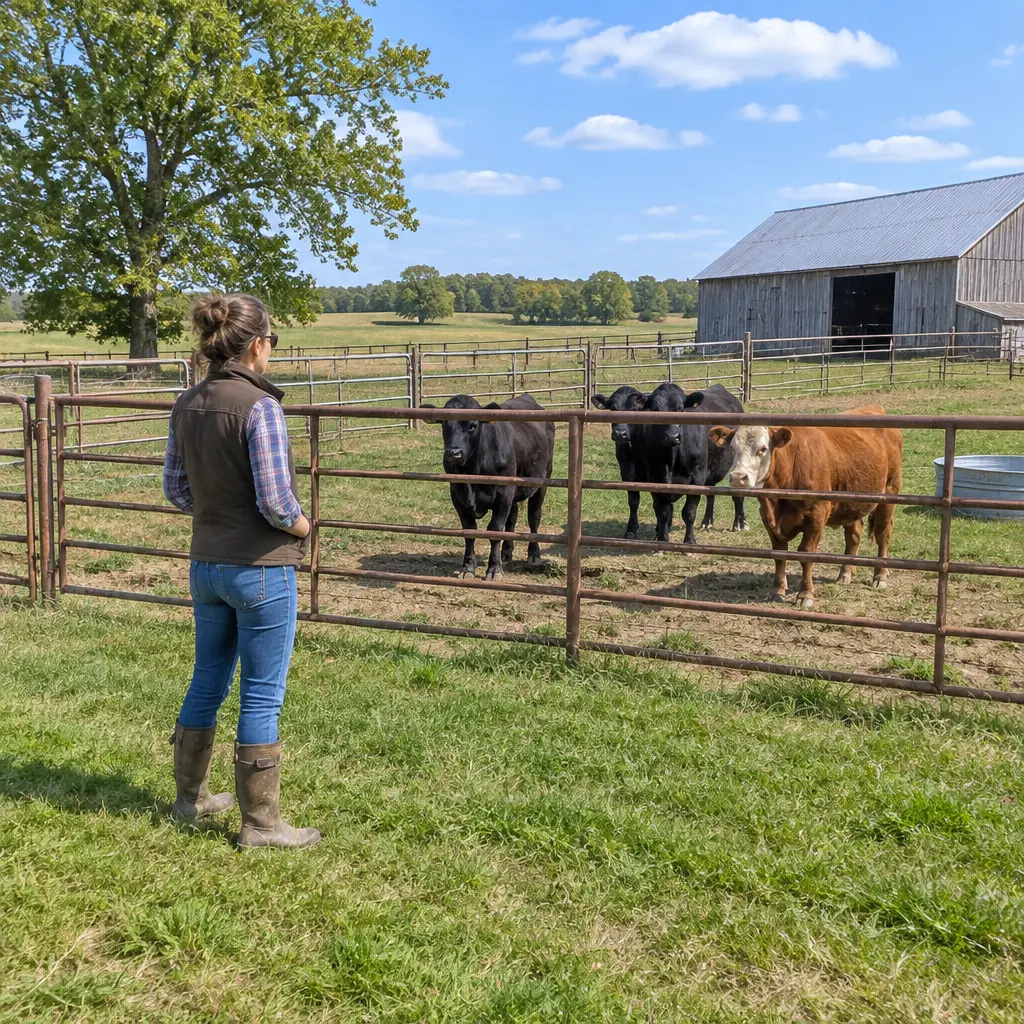
Livestock handling skills are the practical ways people observe, approach, move, and work around farm animals while reducing risk to both animals and handlers. Before touching cattle, sheep, goats, pigs, or other livestock, learn to read their behavior, understand their flight zone and point of balance, plan an escape route, and use calm, low-stress movement. These skills matter: the U.S. Bureau of Labor Statistics recorded 417 fatal work injuries in agriculture, forestry, fishing, and hunting in 2022, while the National Institute for Occupational Safety and Health (NIOSH) identifies animal-related incidents as a major source of injury in agriculture. Good handling begins before contact—with preparation and observation—not with force.
Assessing Livestock Behavior Before Touching Animals
Pre-contact assessment is the deliberate observation of an animal and its surroundings before a handler enters its space or attempts to guide it. Temple Grandin, an animal-science researcher known for her work on livestock behavior and facility design, emphasizes that understanding how animals perceive their surroundings helps handlers reduce fear and improve movement. The assessment combines species knowledge with attention to the individual animal, the group, and the physical environment.
Useful indicators include an animal’s posture, head position, ear orientation, movement, breathing, vocalization, and attention to nearby people or objects. No single sign proves an animal is calm or about to charge: interpret behavior in context and watch for changes. Animals may react to unfamiliar sounds, shadows, reflections, slippery floors, sudden movement, or separation from companions. A behavior that appears unusual can also reflect pain or illness, so handlers should not assume that every animal is simply uncooperative.
Recognizing Fear, Agitation, and Discomfort
Behavioral observation means noticing signs that an animal may be frightened, distressed, defensive, or unwell before moving closer. Possible warning signs include repeated attempts to retreat, tense or rigid posture, rapid head movements, pinned ears, pawing, charging, persistent vocalizing, or sudden changes in breathing. These signs vary by species and individual; an animal can also appear quiet while remaining stressed. Pause, increase distance, remove avoidable distractions, and seek experienced help if the animal’s response is escalating.
The World Organisation for Animal Health (WOAH) describes animal welfare in terms of an animal’s physical and mental state in relation to the conditions in which it lives and dies. That broader view is relevant to handling: avoiding injury is essential, but so is limiting unnecessary fear and distress. A calm, predictable approach supports welfare and helps handlers identify when behavior may signal a health concern rather than a handling problem.
Understanding Species and Individual Differences
Species-specific handling means adapting approach and movement to the animal’s natural behavior, body size, and social habits. Cattle often respond to group movement and pressure around their flight zone; sheep commonly follow one another; goats may be more inclined to investigate or seek gaps; and pigs can be sensitive to noise, footing, and sudden changes in direction. These are general patterns, not guarantees. Breed, age, previous handling, health, and the presence of young can all affect an individual’s response.
For a useful comparison, the National Farm Animal Care Council’s species-specific codes of practice address recommended care and handling for animals including cattle, sheep, goats, and pigs. Before working with a species or unfamiliar group, consult the relevant code, farm procedures, and an experienced stockperson. Do not rely on a general technique if the animal’s behavior or facility layout calls for a different approach.
Planning Safe Livestock Handling Before Contact
Handling preparation is the process of checking the people, equipment, animals, and work area before beginning a task. NIOSH agricultural safety guidance recommends planning animal work, using suitable facilities, and avoiding actions that can startle or provoke livestock. In practice, this means knowing the task and its endpoint, identifying hazards, and agreeing on who will do what before anyone enters the animal’s space.
The stakes are substantial. The U.S. Bureau of Labor Statistics reported 417 fatal occupational injuries in the agriculture, forestry, fishing, and hunting sector in 2022. This sector-wide figure includes many hazards and is not a livestock-handling-only count, but it reinforces why preparation, communication, and task-specific training matter.
Checking the Work Area and Escape Routes
A work-area check is a quick inspection of the route, pen, gate, floor, and nearby equipment before handling starts. Look for broken fencing, loose objects, sharp edges, slippery or uneven footing, poor lighting, narrow gaps, and anything that could trap a person or animal. Confirm that gates swing freely and can be operated without standing in a pinch point. Keep a clear way to step out of the animal’s path; do not position yourself between an animal and a solid barrier.
The Occupational Safety and Health Administration (OSHA) advises agricultural employers to address workplace hazards through appropriate training and safety practices. A practical pre-task check translates that principle into action: correct hazards where possible, change the plan when they cannot be corrected, and postpone work if conditions make safe handling unrealistic.
Choosing Protective Equipment and Getting Help
Personal protective equipment (PPE) is clothing or equipment selected to reduce exposure to specific workplace hazards. Depending on the task and farm rules, this may include sturdy footwear with good traction, gloves, eye protection, or other protective gear. PPE does not replace sound handling practices, and equipment should not create a snag or entanglement hazard. Use tools only if trained in their safe and humane application.
Decide in advance whether the task requires another trained handler. Young or inexperienced workers should not manage a large, agitated, sick, or unfamiliar animal alone. If a handler is uncertain, the safest response is to stop, step back, and ask a knowledgeable person to assess the situation. A brief delay is preferable to escalating an animal’s fear or placing someone in a dangerous position.
Using Flight Zones and Points of Balance to Guide Movement
The flight zone is the space around an animal within which a person’s approach may cause the animal to move away; the point of balance is commonly described as a reference point near the shoulder that affects whether an animal moves forward or backward when pressure is applied from different positions. Grandin’s livestock-handling guidance uses these concepts to explain how handlers can influence movement through position rather than force. The size of a flight zone is not fixed: it can change with temperament, prior experience, surroundings, and the animal’s level of fear.
These concepts are most closely associated with cattle and sheep handling, but the broader principle—use position and timing to guide movement while allowing the animal room to respond—can inform work with other livestock. They are not guarantees of predictable behavior. A frightened or injured animal may react differently, so handlers should preserve an exit route and avoid placing themselves where a sudden movement could cause a crush or kick injury.
Approaching Without Triggering a Flight Response
A low-stress approach is a gradual, visible, and controlled entry into an animal’s space. Move at a steady pace, avoid shouting or sudden gestures, and approach from a position where the animal can see you when practical. Stop or ease back if the animal becomes tense or starts to retreat. Blind spots and species-specific vision mean that an animal may not perceive an approach as expected; never assume it knows where you are.
Grandin’s work on livestock behavior explains that animals can balk at unfamiliar visual contrasts, shadows, and reflections. Before interpreting a refusal to move as stubbornness, check whether the route contains a visible distraction or an abrupt change in flooring or light. Removing the obstacle or changing the angle of approach may be more effective and humane than increasing pressure.
Positioning to Encourage Forward or Backward Movement
Point-of-balance handling uses a handler’s location near the animal’s shoulder as one cue for direction: moving behind the point may encourage forward movement, while moving ahead of it may encourage the animal to slow or turn. The precise response varies, and the concept should be learned under supervision with suitable animals and facilities. Move deliberately and give the animal time to respond; repeated crowding or chasing can increase stress and make movement less predictable.
Pressure-and-release means applying only enough spatial pressure to invite movement, then easing that pressure when the animal responds. It is a timing principle, not permission to intimidate or strike an animal. If the animal does not move, reconsider the position, route, group dynamics, and potential distractions rather than simply increasing force.
Communicating and Moving Livestock Calmly
Calm movement depends on consistent signals, suitable spacing, and clear coordination between handlers. Livestock are sensitive to changes in noise and movement, so predictable actions can reduce confusion. The WOAH standards for animal welfare during transport emphasize competent handling and appropriate facilities; the same practical principles—trained people, suitable routes, and avoidance of needless distress—are useful in routine farm work as well.
Using Voice, Body Language, and Group Movement
Handler communication includes voice, posture, movement, and coordination with other people. Use a calm voice and simple, consistent cues, while recognizing that livestock may respond more strongly to movement and position than to spoken commands. When working as a team, agree on signals and responsibilities before opening a gate or moving a group. Conflicting pressure from multiple directions can confuse animals and increase the chance of sudden movement.
For flocking or herd animals, the group’s movement can help guide individuals, but crowding and separation can also cause distress. Move groups at a pace they can manage, leave adequate room, and avoid forcing animals into bottlenecks. If one animal becomes isolated or agitated, pause and reassess rather than driving the whole group harder.
Avoiding Common Handling Errors
Common errors include approaching too quickly, entering a blind spot, shouting, chasing, blocking an escape route, standing in a pinch point, and assuming that a familiar animal is always predictable. Another frequent mistake is treating balking as disobedience without checking for poor footing, shadows, glare, unfamiliar objects, or a blocked route. These actions can increase fear and make an animal harder to move safely.
A useful response sequence is to stop, create distance, identify the trigger, and adjust the environment or handler position. If the task remains unsafe, end the attempt and get help. Never try to overpower a large animal by hand, and do not work alone when the animal’s size, condition, or behavior exceeds your training.
Conclusion: Make Observation the First Handling Skill
Core animal-handling skills begin before touch: assess behavior, recognize species and individual differences, prepare the work area, and understand how position can influence movement. Flight zones, points of balance, calm communication, suitable protective equipment, and clear escape routes all support safer, lower-stress work—but none replaces sound judgment or hands-on training.
The broader implication is that animal welfare and worker safety are connected. Before the next livestock task, review the relevant species-specific guidance, check the route and equipment, and ask an experienced handler to demonstrate safe positioning. If an animal appears distressed or the situation feels unsafe, stop and reassess rather than proceeding by force.
Sources: U.S. Bureau of Labor Statistics, Census of Fatal Occupational Injuries, 2022, https://www.bls.gov/iif/fatal-injuries-tables/fatal-occupational-injuries-tables.htm; National Institute for Occupational Safety and Health, Agriculture Safety, https://www.cdc.gov/niosh/agriculture/; Temple Grandin, Behavioral Principles of Livestock Handling, https://www.grandin.com/references/new.corral.html; World Organisation for Animal Health, Introduction to the Recommendations for Animal Welfare, https://www.woah.org/en/what-we-do/animal-health-and-welfare/animal-welfare/; National Farm Animal Care Council, Codes of Practice, https://www.nfacc.ca/codes-of-practice; Occupational Safety and Health Administration, Agricultural Operations, https://www.osha.gov/agricultural-operations